Posts

Stock Market Alert Service

Image
Stock Market Alert Service Users who will subscribe to this application should type REG atrad and SEND the SMS to 77000 # NOMonthlyFees   # StockMarcket   # AlertService   # ToSuccess

Sign Up For Free Gifts

Image
For Free Gifts  Click Here For Free Gifts  Click Here  and sign up........

How were the Clocks Developed?

Image
Clocks and watches are used to measure time. Clocks can stand on their own or are hung on the wall, but watches are strapped on to the wrist. There have been many ways of measuring time for many thousands of years. Time was probably first measured by man several thousand years ago by observing the position of the Sun in the sky . Water clocks and sand glasses or hourglasses used changing levels of water or sand in a container to measure time. Candle clocks used to measure time with the burning of candles. Sundials used the movement of the shadow cast by the Sun. The first mechanical time piece was made in China in the 8th century. The clocks previously used springs or weights, but the modern ones use batteries for power. The digital watches show time by numbers on a small screen . 

Who Made the First Telescope?

Image
Galileo Galilei (1564-1642) lived in Italy and is remembered as the first person to turn a telescope to the sky and make important astronomical observations. He built the first telescope in 1609 and then went on to make many. He observed that Moon was not smooth and perfect as it looks, but it was covered with mountains and craters. He also discovered that a pendulum could be used to measure time. He found this by watching a hanging lamp swinging in Pisa Cathedral. He realized that it took exactly the same time for each swing , whether the swings were large or small . He also observed bright satellites of Jupiter , sunspots and other things. The four largest moons of Jupiter are now known as the Galilean satellites. He made himself unpopular because he lived in a time when people believed that the Earth did not move and the Sun and Moon revolved around it. People believed what was written in the Bible. He was imprisoned and ended his life in a house arrest.

When was the First Sextant Used?

Image
Sextant is an instrument that navigators use to find their position. It was invented by John Hadley of Britain and Thomas Godfrey of the United States in 1731. It made navigation easier, and sea travel much safer. The sextant measures how high the Sun or star , such as the Pole Star, is above the horizon. The navigator looks through lenses and mirrors fixed to the sextant and views the Sun or Star and the horizon. A scale on sextant gives the height of the Sun or star. From this and the time of observation , the navigator can work out the position.

When was Radar Invented?

Image
Radar was invented during 1930s. Many countries worked on radar at this time, but the first successful radar was built by Britain in 1935. Radar works by sending out radio signals that bounce off distant objects. The radar set detects the signals that return and produces a picture indicating the position of the objects . British and American scientists worked together to invent methods of using short waves called microwaves.

When were the First Spinning Machines Invented?

Image
People in the olden days used to spin thread by hand . They pulled fibres out of cotton and wool and twisted them together into thread. Spinning machines were invented in Britain in the 1700s. These machines had rollers turning at different speeds to twist the fibres into yarn. James Hargreaves in 1764 produced the first successful spinning machine. It was the hand-powered jenny which produced thin yarn. Richard Arkwright's water frame of 1769, powered by water wheels, gave a sturdy thread. Samuel Crompton combined these two spinning machines in 1779 , to make the spinning mule, which could spin many kinds of yarn. These machines were the precursors of the Industrial Revolution . 

When were the First Mechanical Clocks Made?

Image
The first mechanical clocks are believed to have been made in China in 1088 AD. Later in 1200s, they were first made in Europe. Such clocks made in Europe were driven by a weight on the end of a cord wound round a drum. As the drum rotated, it turned the hands of the clock. The earliest known clock was made in Spain in 1276 AD and the oldest mechanical clock that still works is in Salisbury cathedral in Britain. It was made in 1368. These clocks had devices called escapements to keep the hands turning at the correct rate, so that the clocks depicted the correct time.

Who Invented the Transistor?

Image
A transistor is an electronic device used as a switch or to amplify an electric current or voltage. It was discovered by three American scientists in 1948, namely, William Shockley, John Bardeen and Walter Brattain. The transistor replaced the valve in electronic machines. Being much smaller and more reliable, this made portable radio and television sets possible. Transistors are made of pieces of silicon and can be connected together to produce small, but complex circuits that can handle signals, such as those used in radio and television. In 1970s, single transistors began to be replaced by integrated circuits containing a large number of electronic components.

How is the Distance Between the Earth and Moon Measured?

Image
The distance between the Earth and the moon can be measured accurately by timing how long it takes a laser beam to reach the moon and be reflected back again. A large mirror has been placed on the moon. The speed of light is known, time is measured by this method and distance is calculated by the formula : Speed = Distance/time

Which are the Highest Mountain Peaks of the World?

Image
The world's 20 highest mountains are all in the Himalaya-Karakoram range in Asia. All these mountains are over 8,000 metres high, the highest of them being Mount Everest at 8,863 metres. The highest peak of each continent are Mt. Elbrus in Europe at 5,633 m, Mt. Kosciusko in Australia at 2,228 m, Mt. Vinson Massif , Antarctica at 5,140 m , Mt. Kilimanjaro in Africa at 5,895 m, Mt. Aconcagua in South America at 6, Kinley in North America at 6, 194 m.

Which is the Planet Nearest to the Earth?

Image
Mars is the planet nearest to the Earth. It is half the size of the Earth, but has a mass of only a tenth of Earth's. It is colder and its atmosphere is very thin. It has very high mountains and deep valleys. It's highest peak Olympus Mons is 23 km. high and its largest valley is 4000 km long. Mars has a stony and dusty landscape and dust is blown up and carried for thousands of kilometres by storms . Ice deposits and melts at the pole with changing seasons. The atmosphere is largely carbon dioxide and the surface of the planet is covered with craters , volcanoes and gorges. Mars has two small satellites.

Why is the Sky Blue?

Image
We get the light from the Sun. The sunlight looks white, but is actually a mixture of seven colours namely violet, indigo, blue, green, yellow , orange and red. When the light from the Sun pass through the atmosphere, some rays are scattered by the dust particles suspended in the air. Blue rays are scattered most and reach our eyes from all angles. So we see more blue than any other colour and this makes the sky look blue .

What is a Binary Star?

Image
A binary star or a double star is a pair of stars that revolve around each other and are held together by gravity . The closer a pair of stars are, the faster they revolve. Some binary stars are almost touching and go around each other in a few hours, while others, which are separated by hundreds of times the diameter of the solar system, may take a million years to orbit each other. About a quarter of all known stars belong to binary systems . Most of these, particularly the close pairs, must have been born together. In most cases, one star is large , cool and reddish while the other star is small, white and hot . 

What is a Geostationary Orbit?

Image
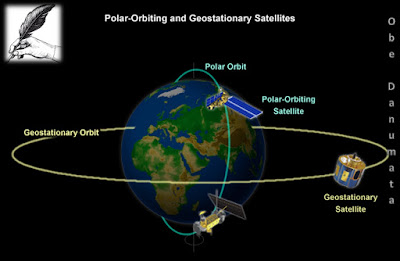
Artificial satellites sent from the Earth orbit around the earth. The ones near the Earth orbit faster than the ones far away. A satellite 35,900 Km above the Earth's surface, takes 24 hours to orbit once. The satellite is always above the same point on the Earth's surface as the planet rotates. Geostationary orbit is also called as geosynchronous ' orbit. Such satellites are used to receive telephone and television signals and retransmit them over long distances.

What is the Big Bang Theory?

Image
The Big Bang theory explains the origin of the Universe . Scientists believe that the Universe was created about 15,000 million years ago in an explosion called the Big Bang . Matter was formed in the tremendous heat that followed and galaxies were created. It is believed that the Universe may expand for ever, or it may eventually stop expanding and then collapse inwards. It is predicted that before this, in about 5000 million years, the Sun will expand and burn the Earth.

What is a Supernova?

Image
A supernova is the result of the violent death of a massive star, larger than the Sun . A star shines as a round ball because of the radiation coming from its centre. When the centre cools down, it collapses producing as much energy in the explosion as a galaxy containing thousands of millions of stars, for a short time. In the first ten seconds of explosion, the star produces 100 times more energy than the Sun has during the whole of its 4.6 billion years lifetime. All that remains of the explosion is an expanding cloud of gas and a neutron star , a few hundred kilometres across.

What are Sun Spots?

Image
Sunspots are huge cool patches on the Sun's surface . Beneath the Sun's brilliant surface, the churning gases can produce strong magnetic fields. This magnetism siphons away heat, forming cooler and darker sunspots. Sunspots range in size from a few thousand kilometers across to tens of thousands (much much larger than the earth) kms . Most of them last for less than a month. They are more common about every 1 1 years, a period known as sunspot cycle. During it's peak a dozen sunspots may be visible. Vast explosions known as flares sometimes occur near or inside sunspots. These send out extra bursts of particles reaching beyond the Sun's corona.

Why do the Planets Revolve Around the Sun?

Image
If the planets did not revolve, the Sun's gravitational pull would drag them inwards . If they moved very quickly, they would fly off into the space. The closer a planet is, the faster it must move . All the planets move in the same direction, because probably they were formed from the same spinning cloud of material that also made the Sun. All the planets except Venus and Uranus spin in anti- clockwise direction.

What is the Sun's Corona?

Image
When the moon passes completely in front of the Sun during an eclipse, a glowing halo shines out. This is known as Corona or Sun's atmosphere. But it, in no way, resembles our atmosphere. It has a temperature of a million degrees centigrade and is a million times thinner than air. Normally , it hides from the view due to the Sun's brilliance except during an eclipse The Corona contains hydrogen, nitrogen oxygen and other common elements. They are very hot and scattered far apart. Unlike our atmosphere, which is held to the Earth by gravity, corona is pouring off into space at a speed of about 400Km/s. These clouds of atoms pass the planets and the Sun towards the stars. This movement of atomic particles is called solar wind.